Unknown Facts About the Indonesian Language: Unveiling the Lingua Franca of the Archipelago
Indonesia, a vast archipelago with boundless cultural and linguistic richness, has one language that has successfully united hundreds of ethnic groups and dialects: Indonesian. Amid this stunning diversity, Indonesian stands tall not only as a tool for communication but also as a pillar of national identity. However, how well do we really know the language we use every day? There are many Unknown Facts About the Indonesian Language that may not be widely known, even by native speakers themselves. This article will take you on a deeper dive into the uniqueness, history, and dynamics of the Indonesian language, revealing fascinating aspects that are often overlooked and relevant to our understanding in the current year.
An Amazing Origin Story: From a Trade Language to a National Identity
One of the most fascinating facts about the Indonesian language is how it evolved from a regional lingua franca into a national language. Its roots can be traced back to Old Malay, which was used for centuries as a language of trade, diplomacy, and religion throughout the Indonesian archipelago. Traders from all corners of the world—India, China, the Arab world, and even Europe—used it to communicate, demonstrating its efficiency and flexibility. Malay was a “neutral” choice, not exclusively tied to any particular ethnic group, thereby facilitating its widespread acceptance and preventing the cultural dominance of one ethnic group over another.
A pivotal moment in the history of the Indonesian language occurred on October 28, 1928, during the Youth Pledge. Young people from various regions pledged three key points, one of which was “Upholding the language of unity, Indonesian.” This was a visionary and revolutionary decision. Amid the dominance of Dutch as the language of colonial administration and education, the choice of Indonesian (which at the time was still very similar to Malay) was a powerful declaration of identity and cultural resistance. This decision was not without reason; Malay was considered simpler, easier to learn, and already well-known in many regions, making it an ideal foundation for building the unity of a newly independent nation.
A Language Rich in Borrowings: A Linguistic Melting Pot
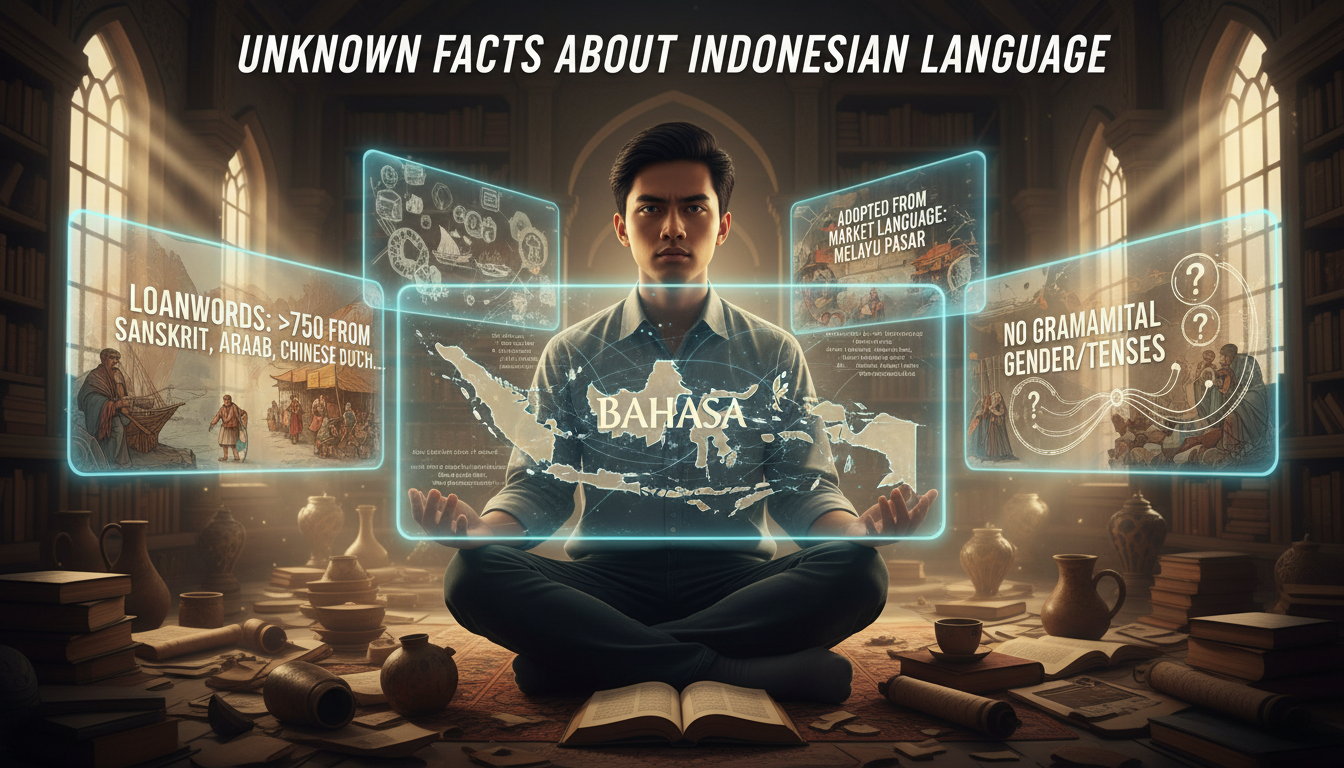
Indonesian is often referred to as a “borrowing-friendly language” due to its ability to absorb and adapt words from various other languages. This is a direct reflection of Indonesia’s long history of interaction with the outside world and its internal diversity. For example:
Sanskrit: Many words in Indonesian have Sanskrit roots, particularly those related to religious, philosophical, and ancient literary concepts. Examples: language, culture, karma, temple, aerospace, ocean, joy. This demonstrates the strong Hindu-Buddhist influence of the past.
Arabic: The arrival of Islam brought significant Arabic influence, particularly in religious, legal, and governmental vocabulary. Examples: community, mosque, scripture, judge, just, greeting, world, knowledge, destiny.
Dutch: As the colonial language for over 300 years, Dutch left a deep imprint on everyday vocabulary, particularly regarding administration, technology, and household items. Examples: office, police, ashtray, towel, fare, invoice, stamp, receipt.
Portuguese: Although not as long as the Dutch, the Portuguese were the first Europeans to arrive in the Indonesian archipelago in the 16th century, contributing words that are still used today. Examples: shoes, table, window, church, pen, party, flag.
Chinese: Centuries of intense trade and immigration interactions with China have also contributed several words, particularly those related to food and merchandise. Examples: meatballs, tea, Chinese cabbage, lipstick, merchant, noodles.
English: In the modern era, the influence of English is strongly felt, particularly in the fields of information technology, science, pop culture, and global terminology. Many new terms are adopted directly or adapted phonologically. Examples: online, gadget, internet, computer, email, blog, influencer, startup.
This adaptability not only enriches the vocabulary but also reflects the inclusive nature of the Indonesian language. These words are not merely borrowed but also adapted in spelling and pronunciation to align with Indonesian phonology, making them an integral part of our ever-evolving linguistic heritage.
Simple Structure, Rich Expressive Power
For many foreign language learners, Indonesian is often considered relatively easy to learn, at least in terms of basic grammar. This is due to several unique features that distinguish it from many other languages, particularly European languages:
No Grammatical Gender: Nouns in Indonesian do not have gender (masculine, feminine, neutral), unlike many European languages or Sanskrit. The word “dia” can refer to a man or a woman, and there are no changes in adjective forms based on gender.
No Verb Conjugation: Verbs do not change form based on the subject or tense. Tense (past, present, future) is indicated by time adverbs (e.g., “yesterday,” “now,” “tomorrow,” ‘later’) or the sentence context. Examples: “I am eating” (present), “I have eaten” (past), “I will eat” (future).
Flexible Pluralization: Plural forms are not always marked by specific word changes or suffixes. They can be formed by word repetition (e.g., “buku-buku” for “many books”), by adding quantifiers (e.g., “some books,” “many books,” “five books”), or often simply by context.
However, behind this basic simplicity, Indonesian has a very rich and complex affixation system, which allows for the formation of new words and the addition of subtle shades of meaning. Prefixes, suffixes, infixes, and confixes can drastically alter the part of speech, meaning, and grammatical function of a base word. For example, from the base word “ajar,” it can become “mengajar” (to teach), “diajar” (to be taught), “pelajar” (a student), ‘pengajaran’ (the process or result of teaching), “terpelajar” (educated), and so on. This is what provides the richness of expression and linguistic flexibility of the Indonesian language, allowing its speakers to convey complex ideas with precision.
Dynamic Evolution: A Language That Continues to Grow and Adapt
Indonesian is not a rigid, static entity; it is a living language that continues to evolve, reflecting the dynamics of its society. Since independence, there have been significant efforts to standardize and modernize the language through institutions such as the Language Center (now the Language Development and Promotion Agency). This process involves standardizing spelling, creating new terms for modern concepts (especially in science, technology, and administration), and developing major dictionaries such as the Kamus Besar Bahasa Indonesia (KBBI), which is regularly updated.
Regional influences also continue to shape the Indonesian language. Although Indonesian is the unifying language, the rich local dialects across the archipelago remain vibrant and often influence one another. Words from Javanese, Sundanese, Minangkabau, Balinese, and other languages frequently find their way into everyday conversation, particularly in areas with multi-ethnic populations. Additionally, Indonesian must adapt to popular culture, social media, and global trends, giving rise to various forms of dynamic slang and colloquial language, particularly among young people. This adaptation demonstrates the language’s vitality and its ability to remain relevant amid rapid societal changes.
Crossing Borders: The Global Footprint of Indonesian
Although often considered a regional language, the reach of Indonesian is actually far broader than imagined. With over 270 million people in Indonesia, and millions of second-language speakers in neighboring countries such as Malaysia (where the closely related Malay language is spoken), Singapore, Brunei, and even in East Timor and diaspora communities across various nations, Indonesian is one of the world’s most widely spoken languages. The language is also taught at many universities across the globe, from Australia to the United States, Japan, Korea, and European nations, and serves as a fascinating subject of linguistic study.
Indonesia’s strategic role in Southeast Asia and on the global stage further enhances the relevance of the Indonesian language. In international forums such as ASEAN, Indonesian is gaining recognition and being used in various contexts, particularly in diplomacy, regional trade, and cultural exchange. This demonstrates that Unknown Facts About the Indonesian Language extend not only to its history but also to its growing global potential as a significant language on the international stage.
Navigating Nuances: The Role of Professional Translation in a Global Context
Although Indonesian is known for the simplicity of its grammar, its rich nuances, cultural context, and specific terminology can pose serious challenges for precise communication, especially regarding important documents. This is where the role of professional translation becomes crucial. Whether for legal, technical, academic, medical, or business documents, accuracy and a deep understanding of context are essential to avoid harmful misunderstandings or even legal consequences.
Professional translators not only master two languages but also understand the intricacies of culture and field-specific terminology. For documents requiring official and legal recognition, such as birth certificates, diplomas, business contracts, or litigation documents, a sworn translator is a must. These are individuals who have undergone an official certification process and possess the legal authority to authenticate translations, ensuring the integrity and validity of such documents under the law, both domestically and internationally. If you are dealing with such important documents and require assurance of their validity, understanding the intricacies of sworn translation is crucial. Comprehensive resources like the Ultimate Guide to Indonesian Sworn Translators can provide invaluable insights into this specialized field, ensuring your documents are translated with precision, legally recognized, and ready for any official purpose.
Other Facts You Might Not Know About the Indonesian Language
One of the Most Studied Languages: In Australia, Indonesian is one of the most widely taught foreign languages in elementary and secondary schools, as well as at universities, reflecting the geographical proximity and bilateral relations between the two countries.
A Significantly Growing Vocabulary: The Great Dictionary of the Indonesian Language (KBBI) is regularly updated. The latest online version, KBBI V, contains over 127,000 word entries and continues to grow, reflecting the language’s dynamic evolution and the incorporation of modern terms from various fields.
Sistem Ejaan yang Disempurnakan (EYD) and Ejaan Bahasa Indonesia (EBI): The Indonesian language has undergone several changes in its spelling system for standardization and ease of use. From the van Ophuijsen Spelling (1901), the Soewandi Spelling (1947), to EYD (1972) and now EBI (2015), this process continues to ensure consistency and accuracy.
Intonation and Stress Are Crucial: Although it lacks tones like Mandarin, intonation and stress in Indonesian can alter the meaning of a sentence, particularly in questions, commands, or when conveying specific emotional emphasis. This is a vital aspect of spoken communication.
Conclusion
From its roots in Old Malay to its status as a dynamic and modern national language, Indonesian is a linguistic marvel. Its evolutionary story is a direct reflection of Indonesia’s history, culture, and ideals of unity. With a relatively simple yet richly expressive structure, its ability to absorb diverse influences, and its central role in uniting hundreds of millions of people, Indonesian is far more than just a tool for communication; it is the beating heart of the nation’s identity.
Learning and gaining a deeper understanding of Unknown Facts About the Indonesian Language will enrich our appreciation for this extraordinary language. It is a language that continues to grow, adapting to the digital age and globalization, and embracing the future, while remaining faithful to its unifying roots. Let us continue to explore and celebrate the endless richness of the Indonesian language.
Unknown Facts About Indonesian Language: Revealing the Lingua Franca of the Archipelago

One response to “Unknown Facts About Indonesian Language: Revealing the Lingua Franca of the Archipelago”
-
Hi, this is a comment.
To get started with moderating, editing, and deleting comments, please visit the Comments screen in the dashboard.
Commenter avatars come from Gravatar.

Archive
Recent Posts
- Sworn Translation for Visa and Immigration Applications: A Step-by-Step Guide
- The Legal Basis of Sworn Translation in Indonesia: Regulations and Ministerial Decrees
- How to Choose a Reliable Sworn Translation Service in Indonesia
- Sworn Translation Costs in Indonesia: Pricing Guide and Fee Factors
- Which Documents Require Sworn Translation in Indonesia?
Tags
certified translation document legalization document translation immigration documents Indonesia Indonesia regulations legal basis legal documents legal translation ministerial decree official documents pricing guide regular translation sworn translation sworn translator translation certification translation cost translation services translator career translator certification visa application
Leave a Reply